3 Powerful & Timely Dystopian Novels of 2025
JULY 15TH, 2026
Three Powerful Dystopian Novels of 2025
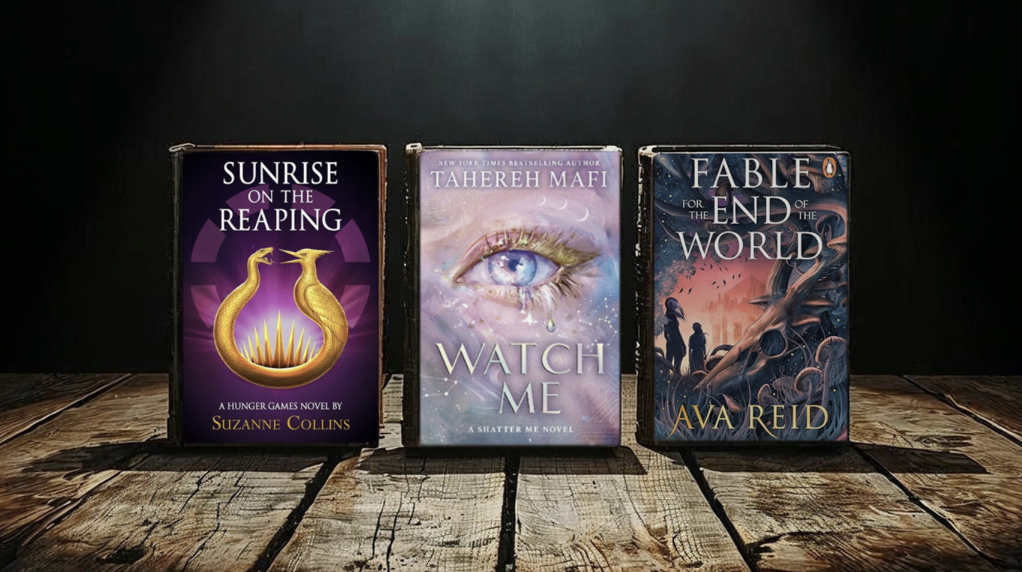
Right now, dystopian fiction is making a comeback. Three of our favourite authors, Suzanne Collins, Tahereh Mafi, and Ava Reid, published dystopian novels in 2025.
In the 2010s, dystopian fiction had themes around government control and feminism. These 2025 books look at how technology and propaganda can control us, and at the power of corporations.
1. Sunrise on the Reaping by Suzanne Collins
It's now the 50th Hunger Games. The small group in the Capitol of Panem use propaganda to keep itself in power. Politics is embedded in the decisions made by the Game Makers, which helps favoured participants.
Why It’s Great: This isn’t about surviving the blood slaughter of the arena trials. Instead, the Games are about controlling the population.
With Sunrise on the Reaping, I was inspired by David Hume’s idea of implicit submission and, in his words, ‘the easiness with which the many are governed by the few’. Suzanne Collins
With Sunrise on the Reaping, Collins urges her readers to consider 18th-century philosopher David Hume’s work and question why so many accept the rule of a powerful few, even when it’s not in their own interest and leads them to be worse off.
Collins cites Hume’s work on “implicit submission” as a major influence on her writing. Hume argues that people comply when they are afraid of punishment. After doing the same things over and over, they will automatically follow the rules. Propaganda is used to reinforce this behaviour, so people don't question it. This is how "implicit submission" is created, and people become hopeless about their situation, making it even less likely they will rebel.
In today’s social media world, algorithms show users more and more of what they already believe to keep people’s attention. The result? An echo chamber of fast-spreading, personalised social media propaganda.
2. Watch Me by Tahereh Mafi
Watch Me, a spin-off of the Shatter Me series, is set ten years after the last book and follows two new protagonists with an enemies-to-lovers romance. While Juliette and Warner from Shatter Me now lead the New Republic, one part of the old regime survives on an Island and uses surveillance and an advanced AI system to watch over the population. The book follows Rosabelle, a trained assassin living on the Island, and James, Warner's younger brother, who deliberately becomes a prisoner there.
Click here for reviews of Watch Me
Why It’s Great: A high-stakes romance mixed with a sharp take on identity and privacy. Like Sunrise on the Reaping, Watch Me leans into the idea that ‘for your own safety’ surveillance might not be so innocent after all. When people get scared, they are a lot more willing to trade freedom for a sense of security that this surveillance brings - something that David Hume clocked centuries ago!
3. Fable for the End of the World by Ava Reid
Debt is a death sentence. The corporation Caerus forces those with overwhelming debt to nominate a family member to take part in a televised death hunt. Inesa's mum amasses huge debt by buying luxuries for herself and nominates Inesa to settle it. Inesa is forced to go on the run from trained assassin Melinoë, while cameras watch both girls' every move. The two girls develop feelings for one another during the hunt. Reid weaves the story so that we develop empathy for both girls, and the budding romance is believable and tragic.
Click here for more reviews of Fable for the End of the World.
Why It’s Great: Reid looks at debt and how mega-corporations can exploit it, creating an uncomfortably realistic dystopian society. Think The Hunger Games meets The Last of Us, with a sapphic love story at its heart.
Last thoughts
Dystopian literature in the 2020s reflects our current fears. Sunrise on the Reaping looks at propaganda. Watch Me examines the dangers of technology spying on us. Fable for the End of the World makes us think about the dangers of corporations larger than our governments. Reading these books makes you think about what could happen in the future.
- Chris
Fiction Rebellion Heroine